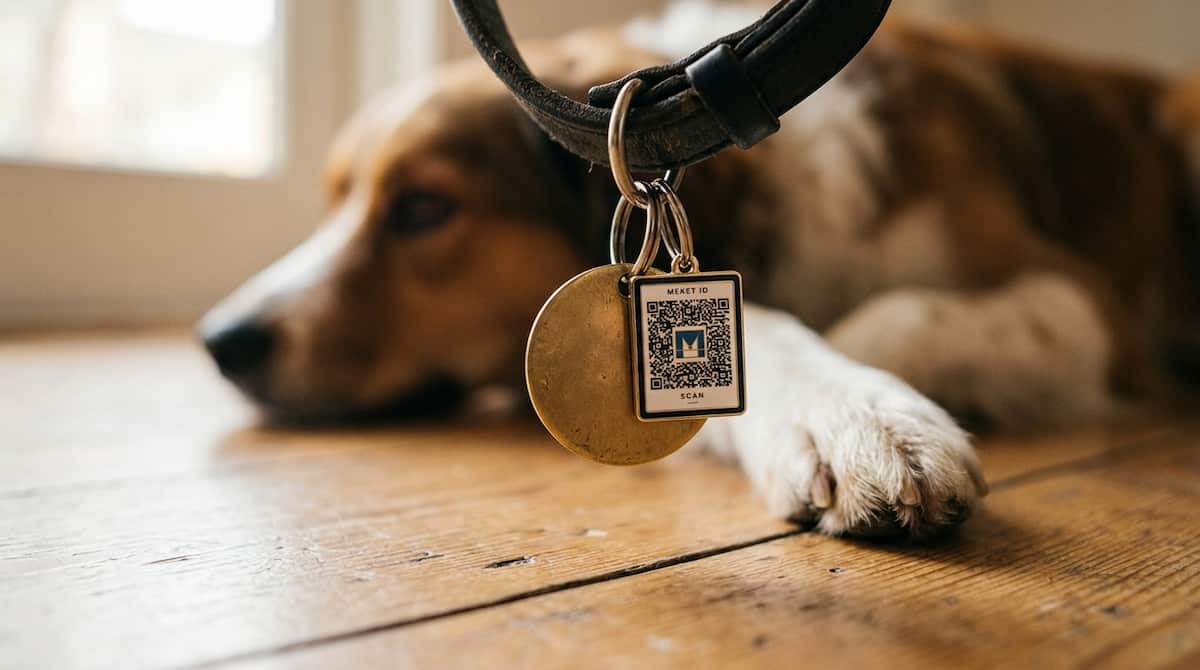
Your dog has a microchip, but the chip can't be seen. Whoever finds them on the street doesn't have a microchip reader in their pocket. What they can read instantly is what hangs from the collar: the ID tag. That's why what you put on it is what separates your dog coming home in an hour from ending up at a shelter waiting for someone to scan them.
The question isn't whether to put a tag — it's what to put so it actually works.
The minimum a tag should carry
There are three pieces of information no tag should leave out:
Your dog's name. It's not a whim. Whoever finds them frightened can calm them by calling their name, get close and hold them before they run off towards a road.
A contact phone number. The most important piece. Make it a number you almost always answer, not the home landline where no one's there at that hour.
The words "I have a chip". It tells whoever finds them that the animal is officially registered and that they should take them to a vet or shelter to confirm identity if they can't reach you.
With this, a traditional engraved tag already does its basic job. The problem starts when the basics aren't enough.
Where an engraved tag falls short
An engraved metal tag has the space it has: two or three lines, usually a name and a phone number. It works for the simple case — a dog that escapes from the garden and a neighbour finds them. But there are situations those three lines don't cover:
- If you don't answer the phone. A tag with a single number is a single point of failure. If you're working, out of coverage or travelling, whoever finds the dog is left with no options.
- If your dog has a medical condition. A diabetic dog that needs insulin, an epileptic one, one with an allergy to a medication. That doesn't fit engraved on a tag, and it can be vital if whoever finds them takes them to a vet.
- If instructions are needed. "He's shy, don't chase him", "don't feed him", "warn before moving". Information that changes how the finder acts and that doesn't fit on a plate.
- If the details change. You change your number, your vet, your city. The engraved tag has to be re-engraved. Usually you don't, and you end up with a tag pointing to an old phone number.
What a QR on the collar solves
A QR code on the collar doesn't replace the tag with the name — it complements it. Whoever finds the dog scans it with their phone, without downloading anything, and sees the information you've decided to show:
- The dog's name and your phone.
- Up to three contacts, not just one. If you don't pick up, there's a real plan B.
- Medical condition, allergies or medication, if any.
- Your instructions: "nervous with strangers", "warn before moving".
- Reference vet and chip number.
And when something changes — your number, your vet — you update it from your phone and the QR keeps working. No need to re-engrave or reprint anything.
The alert that tells you where your dog is
There's one thing neither the engraved tag nor the chip can do: tell you where your dog is at the moment someone finds them.
When a person scans your dog's QR, MEKET asks them whether they want to share their location. If they accept, you and your emergency contacts receive an alert with the exact place where it was scanned. You know what street, what park or what town your dog is in at that moment, without having to wait for the person to explain over the phone where they are.
The location is never captured secretly: it's only shared if whoever finds the dog gives permission. But in practice, someone who has stopped to help a lost dog almost always accepts — they want them home as much as you do.
What should NOT go on the tag
As important as what to put is what to leave out:
- Your address. Whoever finds the dog needs to be able to call you, not know where you live. A tag with your home address is information anyone can read.
- Your own medical details. The tag is the dog's, not yours.
- Too much information. A tag crammed with tiny text isn't read by anyone. Just the right amount, clear and legible.
With a QR, this sorts itself out: you choose field by field what's public. What you don't tick isn't shown when scanned.
How to set up complete identification
The combination that works best is simple:
- Engraved tag with the name and a phone number, always visible.
- QR tag that expands with everything else: extra contacts, medical details, instructions.
- The chip, which remains mandatory and the official identification.
The three work together. The tag solves the quick case, the QR solves the complicated one and tells you where your dog is when someone scans them, the chip closes the legal identification.
The pet profile from MEKET is part of the paid plans: MEKET+ includes your profile plus one pet, and MEKET Family covers your whole family under one account — adults, minors, pets and objects. Generate your dog's QR, print it on a tag or sticker and add it to the collar they already wear. The chip stays where it is.
What you do NOT need to do
- You don't have to replace the tag you already have — the QR goes alongside it.
- You don't have to change the collar.
- Whoever finds the dog doesn't need any app — any phone's camera reads the QR.
See the plans and protect my dog →
A single account covers your entire family. You'll have your dog's QR printed and hanging from the collar this same afternoon.