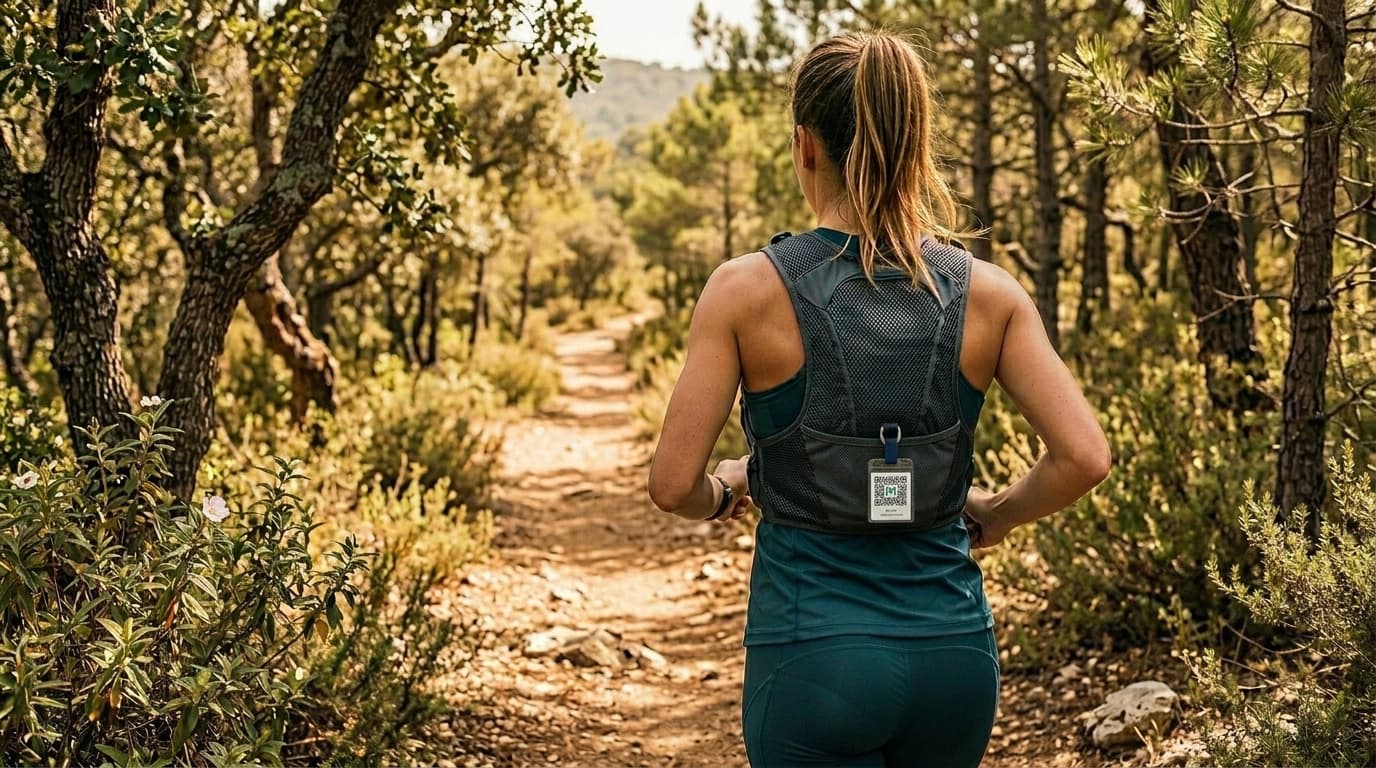
You head out for a run before work. An hour, a familiar route, no one with you. Or it's the weekend and you're off for four hours on the road bike. Or trail running in the hills, alone, with the track on your Garmin and your phone in your vest pocket.
Most of the time you come back. The day you don't, whoever finds you knows very little about you.
They don't know your name. They don't know if you're on anticoagulants. They don't know who to call. And your phone — which has everything — is locked with a PIN no one is going to crack in ten minutes next to a forest track.
This article isn't meant to scare you. It's meant to help you sort something out in under five minutes that almost no one has sorted.
What almost everyone has
Documents at home or in the car. A locked phone. A health card that identifies the holder but doesn't say who to contact or whether they have epilepsy. And on the wrist, if you train with GPS, a watch nobody will know how to unlock.
That's normal. It's not carelessness — it's just that no one has explained it any other way.
The problem isn't that you're being reckless. The problem is that if you're found unconscious on a dirt track, the first person to arrive — a cyclist, a hiker, the rescue team — needs three things in under a minute: to know who you are, to be able to call someone who knows you, and to know whether anything changes how they should treat you. A defibrillator applied to someone with a pacemaker, or morphine given to someone with an opioid allergy, are mistakes that can't be undone.
What the first responder is looking for
A rescuer or paramedic who finds you in the field isn't going to search your pockets hoping to find a full medical history. They're looking for visible identification — fast, with no barriers.
What they need in the first minute:
- Full name and date of birth (to cross-reference at the hospital if you arrive unconscious)
- Emergency contact — someone who will actually pick up
- Medical conditions that change treatment: anticoagulation, pacemaker, type 1 diabetes, epilepsy, allergies to common emergency medications
They don't need your surgical history since 2008. They need what changes what they're about to do right now.
The options available
There are several ways to carry this information with you. None is perfect. These are the most common:
Engraved bracelet or tag. Name, emergency phone, blood type, main medical condition. Weatherproof and battery-free. The limit: can't be updated without ordering a new one.
Laminated card in your vest pocket. Easy to prepare, easy to update. The limit: if the vest isn't on you, neither is the card.
Printed or sticker QR code. Whoever scans it sees your full profile — everything you've chosen to show. Updateable from your phone without changing the physical item. The limit: requires the person who finds you to have a phone with a camera and data connection, and to know to scan it.
A combination of the first two. What many athletes with relevant medical conditions do: engraved bracelet with the critical information (name, contact, condition) plus a QR for the full detail.
None of these is expensive. None requires a subscription. If you don't want to know anything more about MEKET, an engraved bracelet and a laminated card in your vest already puts you ahead of the vast majority of solo athletes.
What MEKET does and doesn't do
MEKET generates a personal QR code linked to a profile you control. What goes in that profile is up to you: contacts, medical data, whatever you want. Anyone who scans it sees it without downloading anything, creating an account, or identifying themselves.
What sets it apart from an engraved bracelet or a printed card: you can update it. If your medication changes, if you add a contact, if you get a new diagnosis — you change it in the app and the physical QR already shows the new information, no reprinting needed.
The paid plans (MEKET+ and MEKET Family) add one more layer: when someone scans your QR and agrees to share their location, your emergency contacts receive an alert with the exact coordinates. It's not continuous tracking. It's a single snapshot at the moment of the scan, only if the person who found you consented to share their position. That's the limit, and we say it clearly — a system that promises what it can't deliver is no use in an emergency.
What MEKET doesn't do: it doesn't locate you if you haven't been found, doesn't alert anyone if no one scans, and doesn't replace emergency services.
The minimum to have in place before your next training session
You don't need to overthink this. Here's what you can have sorted today:
- An emergency contact visible somewhere other than your locked phone.
- If you take relevant medication or have a condition that changes treatment, make sure that information is accessible without a PIN.
- Make sure someone knows you've gone out alone, what time you expect to be back, and what to do if you don't return.
If you want to do this with MEKET, the free plan gives you a complete profile and a downloadable QR in five minutes, no card required. Print it, stick it on your helmet or vest, and head out.
See the plans with scan alert and location →
No app needed to read it. No account. No battery.