Uploading your medical data to the internet feels weighty. It should. You're typing into a screen that you have asthma, that you take blood thinners, the phone numbers of your partner and your parents, and you're telling an app that one day — if something happens to you — it's going to show all of that to a stranger. The legitimate question isn't whether you trust MEKET. The question is: what does MEKET do so that I can?
We answer it without security marketing, because security isn't a badge but a way of operating.
First thing: you decide what is shown
MEKET separates two things at the root: what appears on your QR when someone scans it, and what stays in your private account. They are not the same and they don't mix.
In your account you can store a lot of information. On the public QR only what you mark as visible appears: who to call, allergies, medication, whatever you decide the person who finds you needs to know in order to help you. The rest stays inside and no one sees it when scanning. If you upload your ID, insurance details, long medical notes for your own use or any data you don't want to show, you simply don't mark it as visible and it doesn't come out.
This isn't an option buried in settings. It's the normal way of using MEKET: every field has its own visibility control, and you decide it when editing your profile.
Where your data lives
Your data is stored on European infrastructure. All communication with the app goes over HTTPS, the same as your bank uses. We don't sell your data. We don't pass it on to third parties for advertising. There's no hidden business model that depends on monetising what you upload — MEKET lives on subscriptions to its paid plans (MEKET+ and MEKET Family), and that's all. If that ever changes, we'll tell you before, not after.
Access to your account
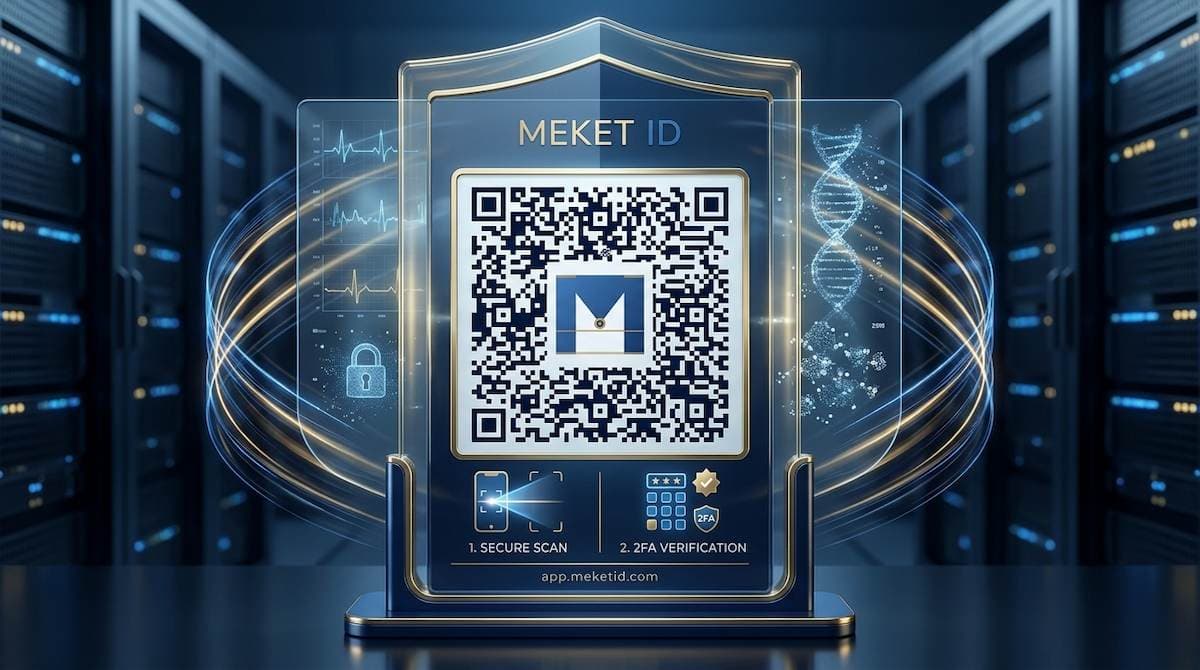
Your account is protected with a password, and we recommend you use two-step verification (2FA) from the app: every time you sign in, in addition to your password, we'll ask you for a one-time code generated by an authenticator app (Google Authenticator, Authy, 1Password or whichever you already use). It's optional, but we especially recommend it if you store sensitive medical information.
A stolen password is no longer enough to get in: you also need the code of the moment, which only lives on your phone.
GDPR: an operational commitment, not a badge
"We comply with GDPR" — everyone says that. Here's what it means in concrete terms at MEKET:
- Medical data only with your explicit consent. We don't upload it by default, we don't assume it, we don't infer it. You enter it, knowing it's medical data, and the system reminds you of that when you do.
- Real right of access. You can see at any time what information we hold about you, from your own account.
- Right to be forgotten without mazes. You can delete your account from the app, and with it your data is deleted. There's no hidden form, no need to write to support, nothing is kept "for commercial reasons".
This last point matters: deleting your account is a button, not an odyssey. We say so because we know many platforms do the opposite.
Whoever scans is anonymous to us
When someone finds your QR and scans it, MEKET doesn't know who that person is. We don't ask for identity, we don't ask for an account, we don't track who has opened your profile. The only thing we record is that your profile has been opened and, if that person decides to share their location, the coordinate at that moment — which reaches you and your contacts, not a database of ours for commercial purposes.
Privacy works in both directions: yours when you upload data, and that of whoever helps you when they scan.
If you lose the physical QR
The QR on your wristband, keychain or sticker does not carry your data inside it. It's a web address: when someone scans it, their phone goes to that address and there it loads your profile from our servers. If you lose the keychain, that person can see your public emergency profile — exactly what they would have seen if they'd found you collapsed on the mountain. They don't get into your account, can't edit you, see nothing private.
And from your account you can deactivate that QR at any moment so it stops loading your profile, or change what information it shows. Whoever finds it later will see an empty profile or whatever you've decided to leave.
In short
Real security means four things, not an advertising promise: that you control what is shown, that your data lives in serious places and is not sold, that you can delete it whenever you want, and that the system takes responsibility for sensitive data instead of passing it on to you. MEKET is built around those four principles. We don't do them to tick boxes; we do them because without that you can't ask anyone to trust their medical data to an app.
Takes you a minute. You decide what is shown. You delete whenever you want.