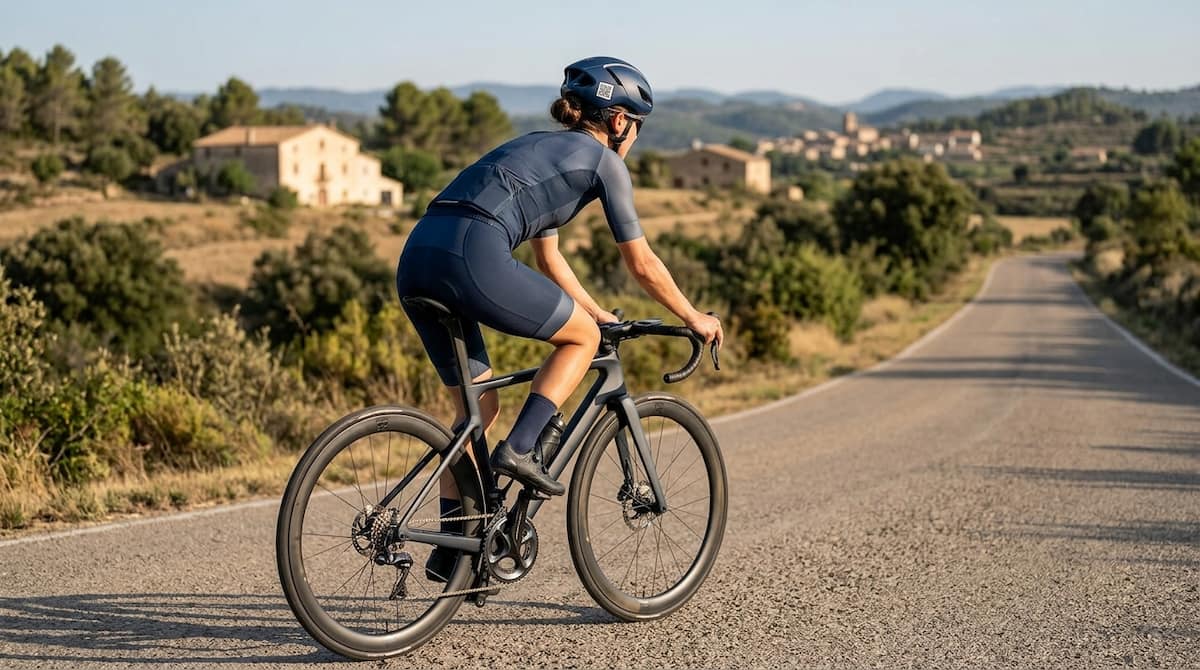
You head out to train alone. A solo ride, a weekend traverse, trail running at dawn with no one around. You crash on a technical descent and lose consciousness. Someone finds you and scans your QR. They see who you are and who to call. But there's a question almost no identification system answers: does anyone at home find out that your QR has been scanned, and do they know where you are?
That's the difference between having your data in a QR and having a system that reacts when it matters. MEKET doesn't just show your information to whoever scans it: it can alert your emergency contacts where you are. But that alert has a condition, and we'll tell it to you straight, because whether you can trust what it does depends on it.
What always happens: your profile opens instantly
When someone finds your QR — on a wristband, a keychain, a sticker or the digital QR — and scans it with their phone, your public emergency profile opens. They see what you've chosen to show: who to call, your medical information, whatever the person helping you needs to know.
This always works. The person doesn't need to register, have the app, or identify themselves. They scan and see your data. That part doesn't fail.
What happens if that person shares their location
Below your emergency contacts the important part appears: the app asks whoever found you to share their location. That request is personalised with your name — it doesn't say "share your location with the holder", it says something like "share your location to help Carme" — and appears in the language of whoever scans, not yours: a French hiker who finds an injured Catalan reads it in French.
If they accept and their phone gets a position, you and your emergency contacts instantly receive an alert via two channels at once: an email and, if you have the app installed with notifications on, also a notification on the phone. The alert says that someone has opened your emergency profile, and includes the exact coordinates, the time and a link to see the spot on Google Maps.
It's not tracking. It's a single capture at the moment of the scan. Whoever helps you is always anonymous to MEKET: we never know who they are, only where from and when, and only if they consented.
What we won't promise you
There's a case you should know about, because we don't want to sell you something infallible. It can happen that whoever finds you wants to help, taps "share location", but their phone can't get a position: GPS off, no signal on the mountain. In that case the app asks them to turn GPS on and try again. But if it still can't be obtained, the alert doesn't go out.
The alert is reliable when there's a location, and the app does everything it can to get one. But it depends on whoever finds you cooperating and having signal. We tell you this plainly because a system that's honest about its limits is more trustworthy than one that promises what it can't deliver.
Where this fits in the plans
The alert with the exact location and a map link, plus the instant notification on your contact's phone, is what sets the paid plans (MEKET+ and MEKET Family) apart from the free plan. It is, probably, the most differentiating piece compared with other identification solutions: you don't just have the QR and the profile, you have a real-time alert with the location, when someone finds you and cooperates. The details of what each plan includes are on pricing.
In short
Having an emergency QR is the first step. Someone finding out that you've been found and knowing where you are is what turns that QR into something that genuinely helps on the day it happens. MEKET alerts you and your contacts, with the exact location on the map, when someone scans your QR and shares their location. That's the condition, and that's why the alert can be trusted.
You download it, stick it or print it, and head out to train. No app needed to read it. No account. No battery.