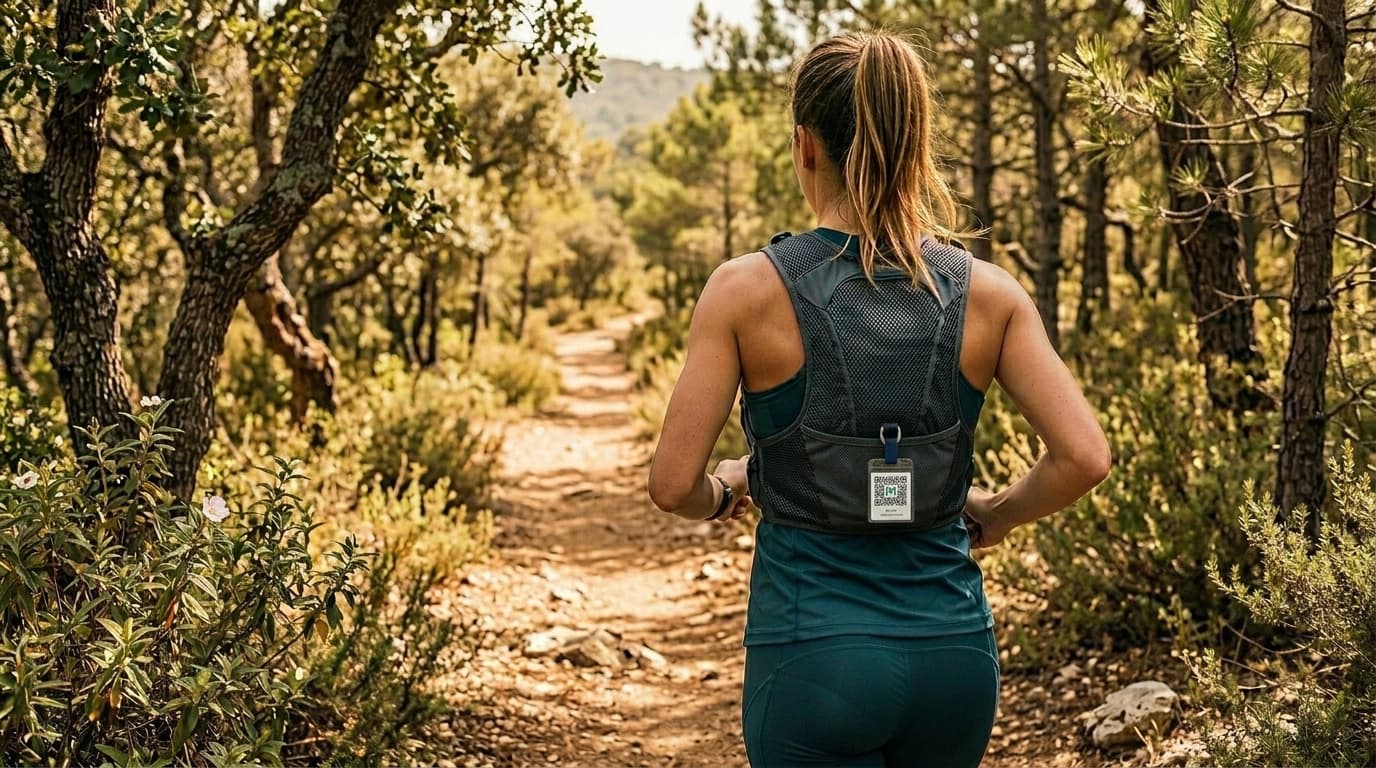
You head out alone to train in the mountains. Trail in the sierra, gravel route, a weekend traverse between unmanned huts. You enjoy yourself until you twist your ankle on a technical descent, run out of sugar three hours from the car or hit a step that wasn't on the track. Most of the time nothing happens. The day something does, whoever finds you needs to know three things in less than a minute: who you are, who to call and whether there's anything that complicates the response.
Your QR should answer those three questions in the order they matter. What follows is what's worth including and where to carry it so it can be seen without anyone having to search you.
Identity and contacts: first
Full name and date of birth. It seems obvious but it lets medical staff confirm your identity if you arrive unconscious at the hospital, and it helps tell you apart if they're treating more than one person at the same incident.
Up to three emergency contacts. The first, someone who'll almost certainly answer the phone: partner, father, mother, sibling. The next, real plan B contacts, not filler numbers. Add the relationship next to the name — "Marta · partner", "John · brother". Whoever calls from a tense situation appreciates knowing who they're talking to before explaining what's happened.
Medical data that can change the response
Blood type and Rh factor. Only matters if you're going to lose blood, of course, but if you do, it saves time at A&E.
Relevant allergies, especially to medications commonly used in emergencies: penicillin, NSAIDs, local anaesthetics, contrast media, latex. A technical fall can end in a suture or an injection. If you're allergic to any of those, it's critical information.
Medical conditions that change the response protocol: diabetes (type I or II), epilepsy, pacemaker, oral anticoagulation, severe asthma, known heart disease. No need for full history — just what affects how they're going to treat you.
Regular medication and dose. If you're on anticoagulants and you have a bleed, the medic needs to know before moving anything.
Medical data that doesn't change the immediate response — food allergies, old surgeries, medication discontinued years ago — is excess. The more cluttered the profile, the longer it takes whoever's treating you to find what matters.
Where to carry it
The QR works anywhere whoever finds you can scan it with a phone. For solo sport in the mountains, the spots that work best are:
- Hydration vest or technical pack: in a front or chest pocket, visible without unbuckling anything. It's the area rescue looks at first.
- Bike or climbing helmet: side sticker on a flat area of the helmet. Water and sweat resistant.
- Bracelet or wristband: if you run light without a pack, the QR on the wrist is the fastest option.
- Race bib in official events: most organisations accept stickers on the lower part of the bib.
What matters is that it's visible without having to search the person. Whoever arrives first at a fall isn't going to empty a backpack — they look for ID at a glance.
In summary
Your emergency QR for the mountains should answer three questions in the right order: who you are, who to call and what a medic needs to know before touching you. Keep the profile short, tidy and up to date. The rest is excess.
Create your free MEKET and set it up for your sport →
You download it, stick it or print it and head out to train. No app needed to read it. No account. No battery.